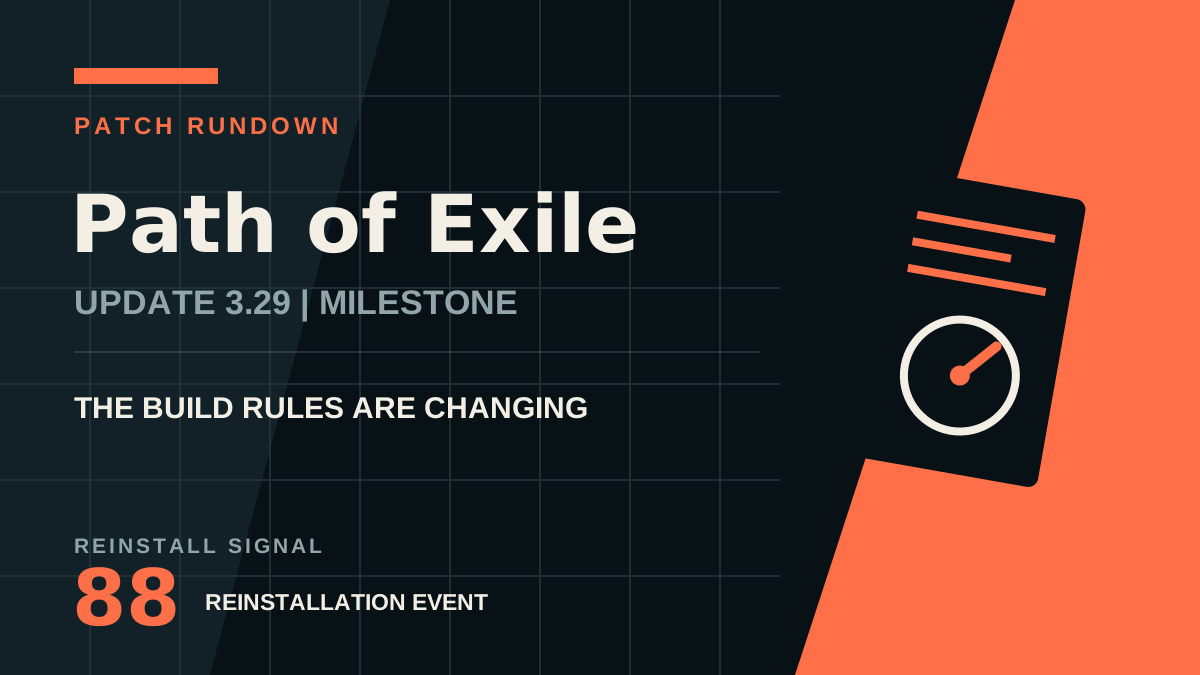
Path of Exile: Curse of the Allflame launches July 24, 2026 at 4 p.m. ET on PC, Mac, PlayStation, and Xbox. Calling it a league update undersells the scope. The seafloor expedition is the headline activity, but the changes that will follow players into ordinary mapping—white sockets, rebuilt legacy mechanics, Atlas Anomalies, a new Scion Ascendancy, and a wide caster rebalance—are the better reason for lapsed players to pay attention.
Before you reinstall, remember that the update is not live yet. Reward rates, stability, and the strongest builds will only become clear after July 24.
What you actually get in Curse of the Allflame
The new challenge league sends players out with the corsair Valerie to recover treasure from the ocean floor. Charts found across Wraeclast unlock dives from The Sovereign. An Allflame-powered lantern protects the expedition for a limited period, creating a push-your-luck loop: explore, collect, and return to the Bathysphere before the light fails.
Charts can then be connected into Voyages. Each chart adds a modifier, while randomized effects along the Voyage Board influence nearby charts and their rewards. The important difference from a disposable side encounter is repeatability. A chart can be revisited, and a Voyage can be shaped around the locations and reward modifiers a player values.
The ship also carries a new crafting system. Items can be split into multiple ghostly outcomes, with one result kept, while Ducats recovered from the seafloor provide further ways to alter gear. Until the live economy settles, it is too early to call this crafting reliable or profitable. It is still a meaningful new reason to engage with the league rather than simply run past it.
The change every normal player will notice
Most item sockets will be white in 3.29. Skills and supports will no longer be blocked by socket color, so a red, green, or blue gem can go into the same ordinary socket. Colored sockets become rarer and instead add quality to a matching gem.
That removes one of Path of Exile’s oldest pieces of low-level friction. Swapping a support, trying a different skill, or upgrading into an off-color armor base should require less busywork. It is especially helpful during the campaign, when a good item could previously be unusable because its colors fought the planned links.
The simplification does not make building simple. Rare colored sockets now have optimization value, and established gear advice may need revision. The floor is friendlier; the ceiling has acquired a new set of calculations.
Endgame regulars have several systems to relearn
Abyss is being rebuilt around open cracks that influence nearby enemies and then call up Abyssal hordes. Its jewels, Stygian Vises, Scarabs, and Atlas passive investment are all part of the refresh. Legion receives a reward overhaul centered on Enshrouding Crystals and Vestigial Unique Items. Those new items inherit powerful modifiers from a chosen Unique armor, and they replace Incubators as Legion’s exclusive reward hook.
Mercenaries of Trarthus also return. Beating a Mercenary can award the item it carries and recruit it for the rest of the area. In Maps, a Warrant can bring a particular Mercenary back later with the same skills and a different set of items. Scion players get the most dramatic version of the system through the new Luminary Ascendancy, which can permanently hire and re-equip a Mercenary companion.
Atlas Anomalies add another endgame decision. Completing Maps affected by a Voidstone can reveal a one-use location tied to an Atlas quadrant. The examples range from a Cadiro Perandus shop to a fully revealed Heist Blueprint wing. These are not a full Atlas replacement, but they make ordinary mapping feed a new layer of opportunistic runs.
Spellcasters and flexible builders benefit most
Grinding Gear Games says more than one hundred spells have been rebalanced, with particular attention paid to characters who cast directly. Assassin, Inquisitor, Occultist, and Necromancer receive new or revised caster notables. Staves, mana solutions, caster Uniques, a new Keystone, Exceptional Pacts, Mana-Infused Staff, and additional Transfigured Gems expand the same theme.
That is excellent news for players bored with a narrow set of safe league starters. It is also a warning against locking in a build before the full numerical picture is understood. A broad rebalance creates winners, but it can also invalidate damage estimates, mana plans, and item priorities copied from an older guide.
Abyss and Legion specialists gain fresh reward goals. Scion players get a class-defining experiment. Players who enjoy constructing a route through several interacting systems have the most to look forward to. Anyone seeking a familiar, low-study return will pay the opposite price.
Returning players should start fresh and read first
The Returning Player Tax is D because 3.29 changes both the seasonal layer and several permanent assumptions. A lapsed player must understand Voyages, new crafting, Mercenaries, Atlas Anomalies, revised Abyss and Legion rewards, the socket rule, and whichever balance changes affect a chosen skill. Old guides may remain useful as skeletons, but their gearing and endgame advice cannot be trusted blindly.
The upside is that Grinding Gear Games has confirmed a fresh challenge league economy and a natural reason to begin again. Existing Standard characters remain, but the FAQ warns that balance changes may require a passive-tree respec. White sockets reduce early friction, and the expansion spreads its value across campaign gearing, mapping, class choice, and spell balance instead of hiding everything behind one late boss.
Why an 88? The expansion adds a full league, lowers early gearing friction, refreshes permanent endgame activities, and gives spellcasters and Scion players new reasons to build again. It stops short of the 90s because performance, launch stability, reward tuning, and the final balance picture remain unknown before release.
How 3.29 compares with Mirage
Version 3.28, Mirage, paired its challenge league with the Reliquarian Scion Ascendancy, Exceptional Support Gems, endgame revisions, and the removal of Harbinger as a core league. Curse of the Allflame continues that willingness to revise old content, but reaches closer to everyday build assembly through the socket change and the caster pass.
Mirage asked players to learn Wishes and altered reward spaces. Allflame adds its own board-planning loop, then stacks permanent-feeling changes around it: another Scion identity, two rebuilt league systems, a different Legion reward model, and new Atlas events. On the official feature list alone, 3.29 is the broader return proposition.
What remains unresolved before July 24
The notes cannot answer whether Voyages remain rewarding after repetition, whether the lantern timer feels tense or irritating, or whether Allflame crafting produces useful choices at sensible cost. The same caution applies to Vestigial Uniques, Atlas Anomaly frequency, Mercenary balance, and the real winners of the spell overhaul.
One limitation is already explicit in the notes: Broken Promises, Imperfect Memories, Magnum Opus, and Parasitic Passengers are temporarily disabled, and existing copies cannot currently be turned in. The notes do not give a date for when those Divination Cards will return.
Launch stability still needs live confirmation. Grinding Gear Games says the client can be predownloaded a day before launch, with console predownloads also planned. The announced date and platform coverage are official, but server queues, emergency fixes, and platform-specific delays are release-day facts, not promises that can be graded in advance.
The 100 Patch Impact score fits the scope: this is a major expansion and new season with a class option, endgame additions, broad balance work, and a simpler socket rule. The practical verdict is slightly more restrained: Curse of the Allflame looks worth reinstalling for, but anyone returning should treat July 24 as the start of the answer, not the end of it.